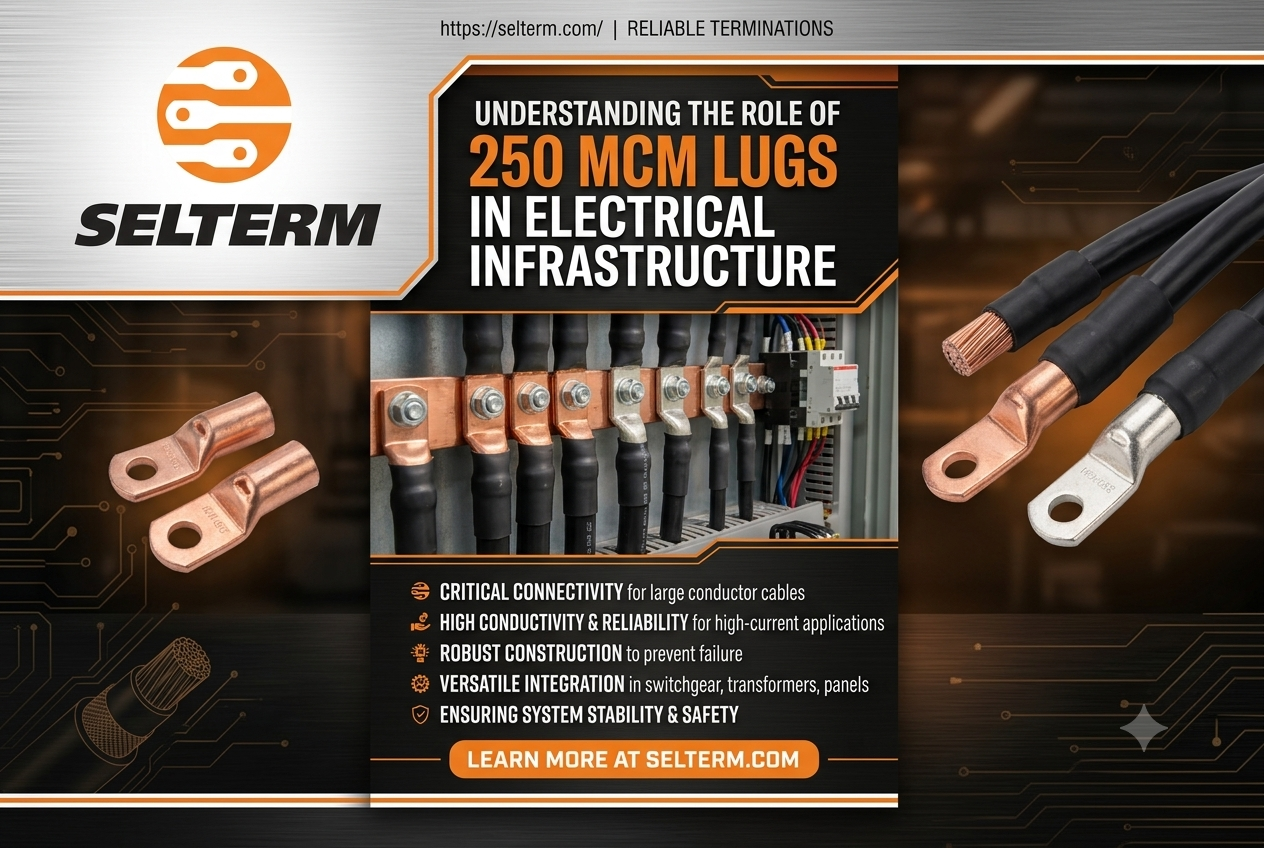
In the demanding world of industrial electrical systems, the integrity of power distribution is paramount. From large-scale manufacturing facilities to complex commercial infrastructure, the ability to safely and efficiently transmit high currents is the backbone of operational success. Among the many components that make this possible, terminal connector play a critical role. Specifically, the 250 mcm lug stands out as a vital interface between heavy-duty cabling and the equipment it powers, ensuring low-resistance connections that prevent overheating, system failures, and potential fire hazards.
When engineers specify electrical connections for high-amperage environments, they must account for the physical size and electrical capacity of the conductors. The use of 250 mcm cable lugs is essential in these scenarios, as they provide the mechanical strength and electrical surface area required to terminate large-gauge conductors securely. These lugs act as the bridge, ensuring that the heavy copper or aluminum strands within the 250 MCM cable are not only held firmly in place but also maintain optimal contact with busbars, circuit breakers, or transformer terminals.
What is a 250 MCM Lug?
To understand its application, one must first understand the nomenclature. “MCM” stands for “thousand circular mils,” a unit of measurement used to describe the cross-sectional area of large electrical conductors. A 250 MCM conductor is a substantial cable, roughly equivalent to 127 square millimeters in metric measurements. Given its size, it is designed to carry significant electrical loads, typically ranging from 200 to 290 amperes depending on the material (copper vs. aluminum) and the insulation temperature rating.
A lug, in this context, is a mechanical device used to connect these conductors to electrical apparatus. Because a 250 MCM cable is too thick and stiff to be wrapped around a terminal screw, a lug is crimped or mechanically fastened to the end of the cable. This creates a flat, manageable surface—often a pad with a bolt hole—that can be easily secured to a connection point.
Primary Industrial Applications
The versatility of the 250 MCM lug makes it ubiquitous in heavy industry. Its usage is primarily defined by the need to handle high currents while maintaining structural integrity under vibration and thermal cycling.
1. Power Distribution Panels and Switchgear
One of the most frequent applications for these lugs is within main distribution panels and switchgear. These units serve as the central hub for electricity entering a facility. Since these panels must distribute power to various sub-circuits throughout a factory floor, they utilize large-gauge feeder cables. The 250 MCM lug provides a reliable, high-conductivity connection point between the incoming feeder cables and the internal busbars of the switchgear, ensuring that power loss at the connection point is minimized.
2. Large Electric Motor Connections
In industrial settings, motors driving pumps, compressors, and conveyors often require massive amounts of startup current. When connecting these motors to motor control centers (MCCs) or variable frequency drives (VFDs), the electrical path must be robust. These lugs ensure that the connection to the motor terminal box remains tight, even when the motor is subjected to the mechanical vibrations characteristic of industrial machinery.
3. Backup Power Systems and Generators
Facilities requiring high uptime, such as data centers or hospitals, rely heavily on industrial-grade backup generators. These generators often output massive amounts of power during a grid failure. The transfer switches and output cabling connecting these generators to the facility’s electrical system utilize heavy-duty cabling. Here, these lugs are critical for maintaining the high-amperage connections that keep mission-critical systems running without the risk of loose or failing terminations.
4. Transformer Terminations
Step-down and step-up transformers are essential components of site-wide power distribution. The secondary side of a transformer, which often delivers power to the facility’s interior, frequently uses 250 MCM cabling to manage the distributed load. The thermal expansion and contraction of these heavy cables can lead to loose connections over time if the termination is not robust. Specialized, high-quality lugs mitigate this risk by providing a secure, vibration-resistant mount.
Material Considerations and Installation Best Practices
Choosing the right material for the lug is as important as choosing the correct size. These connectors are typically available in copper, aluminum, or tin-plated options.
- Copper Lugs: Ideal for applications where copper cable is used. They offer superior conductivity and are the standard for most internal high-current distribution.
- Aluminum Lugs: Often used with aluminum cabling, which is lighter and more cost-effective for long cable runs. However, they must be used with an oxide-inhibiting compound to prevent galvanic corrosion at the contact interface.
- Tin-Plated Lugs: These offer protection against corrosion, making them suitable for environments with higher humidity or exposure to specific chemical vapors found in industrial manufacturing.
Installation is equally critical. Improper crimping is the leading cause of connection failure. Using a hydraulic crimping tool with the correct die set for the specific lug brand and cable size is mandatory. A “cold” joint caused by an inadequate crimp will increase electrical resistance, causing the connection to heat up under load. This heat further accelerates the oxidation of the metal, leading to a feedback loop that eventually destroys the connection.
Conclusion
The selection of appropriate terminal hardware is a fundamental aspect of maintaining a safe and efficient industrial electrical system. By utilizing the correct hardware to match the high-current demands of modern infrastructure, engineers ensure that power flows reliably from the utility source to the end-use equipment. Whether it is in a massive motor installation or a critical data center power bus, the 250 mcm cable lugs you select act as the unsung sentinels of industrial reliability, protecting against the hidden dangers of electrical resistance and mechanical failure. Investing in high-quality components and adhering to strict installation standards ensures that these vital connections stand the test of time, keeping industrial operations running smoothly and safely.