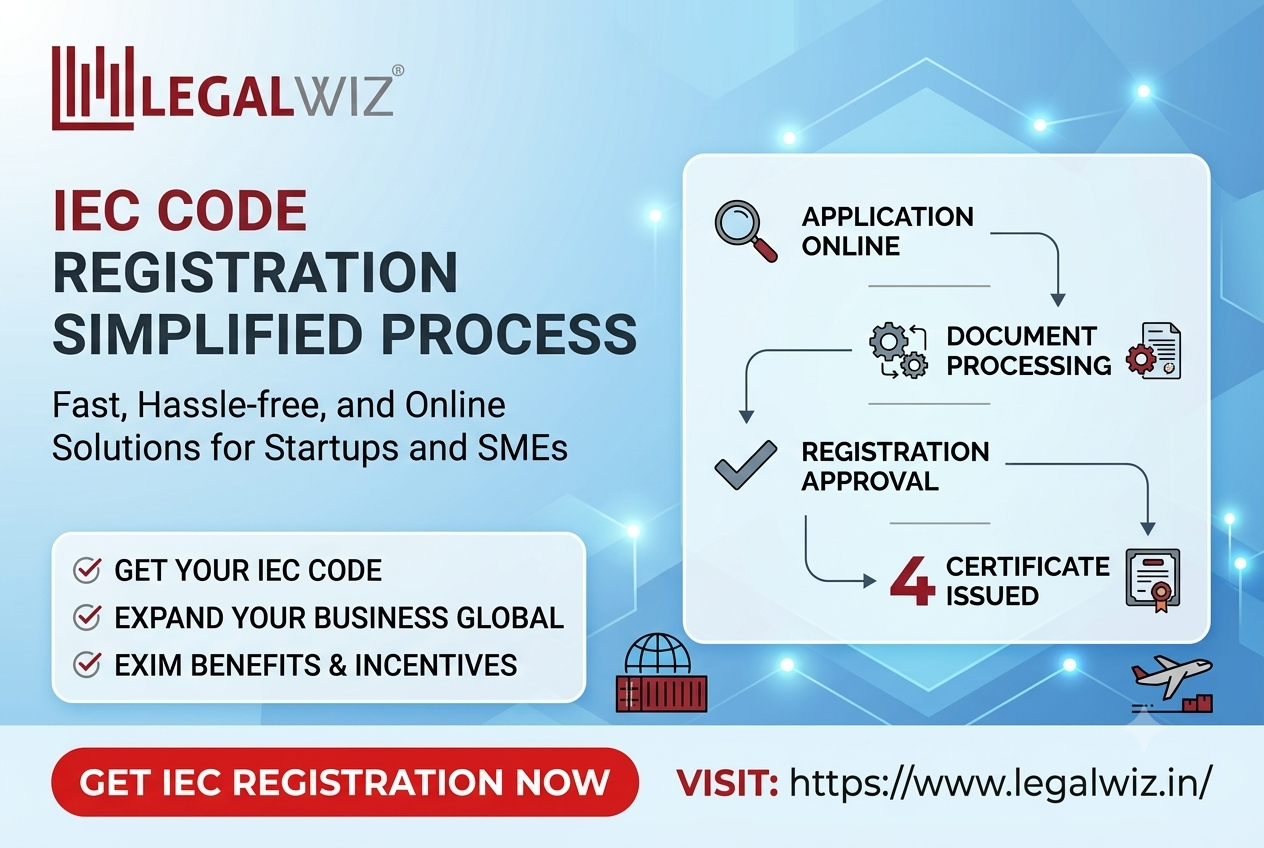
Expanding a business beyond domestic borders is one of the most transformative milestones for an emerging business. Whether an Indian startup plans to ship artisanal goods to international buyers, export software solutions, or source high-quality raw materials from overseas suppliers, one regulatory requirement stands as the entry gateway: obtaining an Import Export Code (IEC).
Historically, securing government trade licenses involved dense paperwork, physical verifications, and prolonged waiting periods. Today, thanks to the digital initiatives of the Directorate General of Foreign Trade (DGFT), Iec Code Registration has been revamped into a paperless, self-declaration process tailored for agile startups and Small and Medium Enterprises (SMEs).
What is an Import Export Code (IEC)?
An Import Export Code (IEC) is a 10-digit primary business identification number issued by the Directorate General of Foreign Trade (DGFT), Ministry of Commerce and Industry, Government of India. It acts as a mandatory license for any entity looking to clear customs, remit funds to foreign vendors, or receive payments from overseas customers.
Key Rule: Following the integration of GST, an entity’s IEC number is identical to its 10-character Permanent Account Number (PAN). However, the PAN alone does not grant import/export privileges — a formal online registration with DGFT remains mandatory to activate trade privileges.
Why IEC Registration is Critical for Startups & SMEs
For early-stage companies, securing an IEC opens doors to global markets while offering strategic advantages:
- Global Market Expansion: It allows small businesses to list on international e-commerce platforms and participate in global tenders.
- Customs Clearance: Customs authorities will not process incoming or outgoing commercial shipments without an active IEC.
- Bank Remittances: Banks require an IEC to process international money transfers, whether paying foreign suppliers or receiving export payments.
- Lifetime Validity: Unlike many trade permits, an IEC is issued for life with zero renewal fees (though annual online updates are required).
- Access to Government Incentives: Registered exporters can claim export incentives under India’s Foreign Trade Policy (FTP).
Prerequisites: Documents Needed Before You Start
Before starting your Iec Code Online Application, keep digital scanned copies (PDF or JPEG format) of these documents ready:
| Requirement | Details |
|---|---|
| PAN Card | Entity PAN (or Proprietor’s PAN for sole proprietorships). |
| Proof of Entity | Incorporation Certificate, Partnership Deed, or GST Registration. |
| Address Proof | Utility bill, rent agreement (with owner NOC), or property tax receipt. |
| Bank Account Proof | Cancelled cheque or bank certificate matching the business name. |
| E-Signing Tool | Aadhaar-linked mobile (for OTP verification) or Digital Signature Certificate (DSC). |
Step-by-Step Process for IEC Code Online Application
The entire registration procedure is conducted digitally on the DGFT portal (dgft.gov.in). Most applications with accurate documents are verified and issued within 1 to 2 working days.
1. Register on the DGFT Portal:
Visit the official DGFT website (dgft.gov.in). Click on Login/Register and select Register as Importer/Exporter. Enter your basic contact details, entity PAN, and complete the dual OTP verification sent to your mobile and email address.
2. Fill Out the Application Form:
Log in with your credentials and navigate to Services → IEC Profile Management → Apply for IEC. Fill in the core business details, including entity type (Proprietorship, LLP, Pvt Ltd, etc.), bank account details, and branch information.
3. Upload Required Documents:
Upload clean, legible copies of your business address proof and cancelled cheque/bank certificate. Ensure that the business name on the bank document exactly matches your PAN records to prevent automated system rejections.
4. Pay Application Fee:
Proceed to pay the mandatory government application fee of ₹500 via the integrated Bharatkosh payment gateway. Payments are accepted through Net Banking, UPI, Debit, or Credit cards.
5. E-Sign and Submit:
Authenticate your submission. Sole proprietors can e-sign using an Aadhaar-based OTP. Directors of Private Limited Companies or Partners in an LLP must authenticate using a Class 3 Digital Signature Certificate (DSC) registered on the portal.
Post-Issuance Mandatory Compliance: The Annual Update
While an IEC code carries lifetime validity with no recurring renewal fee, the DGFT introduced a crucial maintenance requirement:
Annual Confirmation Window: Every IEC holder must update or confirm their profile details on the DGFT portal once every financial year between April 1 and June 30.
Even if no business information (like address, bank, or directors) has changed, logging in to click “Confirm Details” is mandatory. Failing to complete this annual update results in the IEC being placed under deactivation, rendering the business temporarily unable to process import/export transactions through customs. Reactivation is free and occurs automatically once the profile update is completed online.
Common Pitfalls to Avoid During Registration
- Name Discrepancy: The single most common reason for application queries or delays is a mismatch between the entity name on the PAN, bank cheque, and address proof.
- Unclear Scans: Uploading blurry or cropped documents can trigger administrative delays.
- Invalid Bank Certificate: Ensure bank documents explicitly display the account holder’s name, account number, and bank IFSC code.
Final Thoughts
For Indian startups and SMEs, taking the step into cross-border trade is no longer hindered by complex bureaucratic bottlenecks. Through a streamlined Iec Code Online Application, small businesses can secure their trading identifier within 48 hours for a nominal fee of ₹500. Preparing your documents in advance and staying compliant with annual updates ensures your venture remains ready to seize global opportunities seamlessly.