Launching a new brand is an exhilarating milestone. You’ve finalized the perfect name, designed a striking logo, and mapped out your market strategy. However, before you can claim exclusive ownership of your brand identity, you must navigate one of the most critical hurdles in Intellectual Property (IP) law: the trademark search and classification process.
A common misconception among entrepreneurs is that securing a trademark grants absolute, blanket protection across every industry. In reality, trademark rights are deeply tied to specific commercial verticals. If you register a trademark in the wrong category, you could leave your actual products completely unprotected while wasting thousands of dollars.
To ensure a smooth path toward Trademark Registration, you must understand how to decode trademark classes and search within the right verticals.
The Blueprint of Classification: The Nice Agreement
Trademark offices worldwide do not organize brands alphabetically or by company size; they organize them by industry verticals using an international system known as the Nice Classification (NCL). Established by the Nice Agreement in 1957, this system categorizes all goods and services into 45 distinct classes.
- Classes 1 to 34 cover physical goods (e.g., pharmaceuticals, clothing, electronics).
- Classes 35 to 45 cover services (e.g., retail, software development, entertainment, legal services).
When you apply for Trademark Registration, you must select the specific classes that align with your business operations.
The Golden Rule of Trademarks: Trademark protection is a co-existence framework. Two identical names can legally exist if their products or services are entirely unrelated and unlikely to cause consumer confusion.
For example, “Delta” successfully co-exists as an airline (Class 39) and a faucet manufacturer (Class 11). Consumers looking for a flight are highly unlikely to accidentally buy a bathroom sink, meaning there is no market confusion.
Step 1: Identify Your Core Verticals (And Beyond)
Decoding trademark classes requires a precise understanding of your current business model and your five-year growth plan. To categorize your brand accurately, break your offerings down into three distinct tiers:
1. Primary Goods and Services
What is the core product or service you are selling right now? If you run an e-commerce store selling athleisure wear, your primary vertical is Class 25 (Clothing, footwear, and headwear).
2. Operational Services
How do customers access your product? If you sell those clothes exclusively through an online storefront, you might also need to look into Class 35 (Advertising, business management, and retail services).
3. Future Expansion
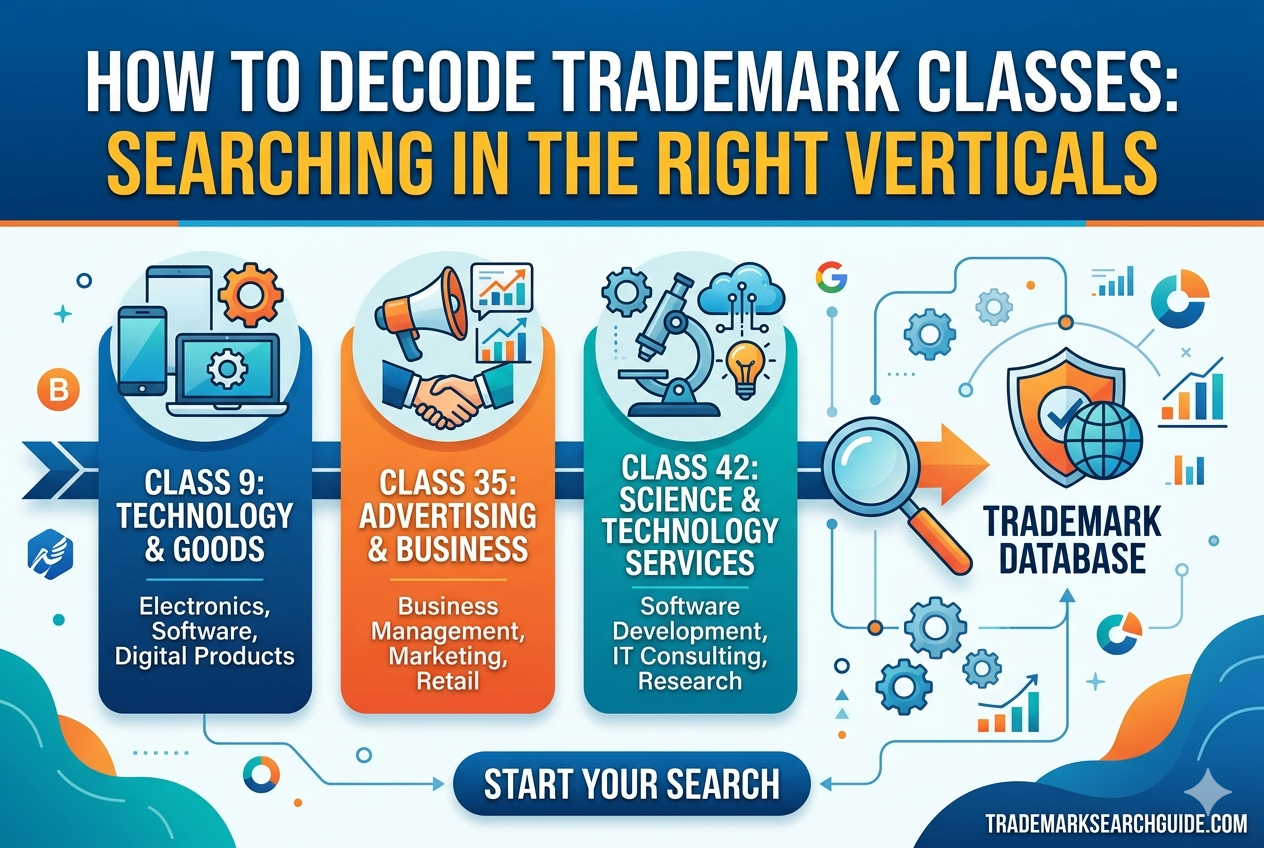
Where will your brand be in three to five years? If your clothing brand plans to launch a line of smart fitness trackers or smartwatches in the future, you should proactively clear your name in Class 9 (Scientific, digital, and software apparatus).
Step 2: Conducting a Strategic Trademark Search
Once you have identified your potential classes, the next step is conducting a comprehensive trademark search. This is not as simple as typing your name into Google or checking if a .com domain is available. You must dive into official government databases, such as the United States Patent and Trademark Office (USPTO) TESS system, the European Union Intellectual Property Office (EUIPO), or relevant national registries.
An effective search must look for two things within your chosen verticals:
Exact Matches
Searching for the exact spelling of your proposed brand name within your target classes. If an exact match exists for a similar product, your application will likely be rejected.
“Confusingly Similar” Marks
This is where most businesses stumble. Trademark examiners look for phonetic similarities, visual similarities, and translated meanings. For instance, if you want to register “Cat’s Meow” for a coffee shop (Class 43), a pre-existing trademark for “The Cat’s Meow” or “Katz Meow” in the same class will likely trigger a refusal based on a “likelihood of confusion.”
Step 3: Navigating Coordinated Classes and Overlaps
One of the biggest traps in decoding trademark classes is failing to account for “coordinated classes.” These are separate classes that are so closely related in the commercial world that a conflict in one can jeopardize an application in another.
Consider the tech and software industry. If you develop a mobile application, you might naturally assume you belong solely in a service class. However, software spans multiple categories:
| Product/Service Type | Proper Nice Class |
|---|---|
| Downloadable Software / Mobile Apps | Class 9 (Goods) |
| Software as a Service (SaaS) / Cloud Hosting | Class 42 (Services) |
| E-commerce / Retail Platforms | Class 35 (Services) |
If you only perform a trademark search in Class 42, you might miss a direct competitor holding an identical name in Class 9. This oversight can result in an expensive trademark infringement lawsuit down the road.
The Hidden Costs of Misclassification
Getting your trademark classes wrong carries heavy consequences. If you accidentally under-file (select too few classes), you leave your brand vulnerable to copycats in adjacent fields. If you over-file (select every class “just to be safe”), you face two major issues:
- Compounded Fees: Trademark offices charge application fees per class. Filing in five classes costs five times as much as filing in one.
- Vulnerability to Cancellation: Trademark rights are built on the principle of “use it or lose it.” If you register a trademark in Class 5 (Pharmaceuticals) but only sell graphic tees, a competitor can easily petition to cancel your registration for non-use.
Final Checklist for a Successful Registration
Before hitting submit on your application for Trademark Registration, run through this final checklist to ensure your verticals are accurately decoded:
- Map the Entire Ecosystem: Have I accounted for the physical product, the digital delivery method, and the retail environment?
- Search Coordinated Verticals: Did I expand my search to include highly related industries and phonetic variations?
- Audit for Current Use: Can I realistically provide “proof of use” (specimens) for every class I am applying for?
- Plan for the Future: Does my selected classification protect where my business is headed, not just where it is today?
By systematically decoding the Nice Classification system and searching within the correct industrial verticals, you protect your brand from legal vulnerabilities. A methodical approach to your initial search saves time, safeguards your capital, and builds a bulletproof legal foundation for your brand’s long-term success.